You can have the right experience, meet most of the job requirements, and still struggle to stand out during an interview.
We see this happen with experienced professionals all the time. They know their work, have managed important projects, delivered results, and developed valuable skills. But when they're asked why they're the right person for a role, their answers don't always communicate the full value of what they bring.
Sometimes they spend too much time walking through their responsibilities. Other times, they focus on what they've accomplished without connecting those accomplishments to what the employer actually needs. And occasionally, they give perfectly reasonable answers that could have come from almost anyone with a similar background.
This is where interview positioning becomes important.
Positioning isn't about making yourself sound more impressive than you are. It's about helping the interviewer understand how your experience, strengths, perspective, and approach to work connect to the challenges they're trying to solve.
The 6 Ps of Strong Interview Positioning to help professionals prepare for that conversation. It gives you six areas to think through before an interview so you can communicate your value more clearly and make a stronger impression.
1. People: Understand Who You're Speaking To
Strong interview preparation starts with understanding the people on the other side of the conversation.
You aren't simply preparing to talk about yourself. You're preparing to speak with a hiring manager, potential colleagues, recruiters, and possibly senior leaders who each have different priorities.
A recruiter may want to understand whether your background meets the requirements of the position. A hiring manager may be more interested in how you approach problems, manage priorities, and work with their team. A senior executive may want to know whether you understand the broader business and can contribute beyond the immediate responsibilities of the role.
The same experience may need to be communicated differently depending on who's asking the question.
For example, imagine you're interviewing for an Operations Manager position. When speaking with a recruiter, you might emphasize your years of operational experience, team leadership, and relevant qualifications. When speaking with the hiring manager, you may need to explain how you've improved processes, handled competing priorities, and supported cross-functional teams.
The experience hasn't changed. You're simply connecting it to what matters most to the person you're speaking with.
How to prepare:
Before your interview, find out who you'll be meeting with and take some time to understand their role. Look at their LinkedIn profile, learn about their responsibilities, and consider what they may want to understand about your background.
Ask yourself:
Who will I be speaking with, and what are their responsibilities?
What will this person likely care most about when evaluating candidates?
How does my experience connect to their team's needs?
What questions might they have about my background?
Understanding your audience helps you make your answers more relevant instead of delivering the same rehearsed introduction to everyone.
2. Problem: Understand What the Company Needs Solved
One of the biggest mistakes candidates make is preparing for an interview by focusing almost entirely on the job description.
The job description tells you what the company expects someone to do. It doesn't always explain why the position exists or what problems the new hire will be expected to address.
A company hiring a Program Manager may be struggling with project delays, unclear ownership, competing priorities, or communication between departments. A company hiring a Marketing Director may need someone to improve demand generation, strengthen its market positioning, or create better alignment between marketing and sales.
Understanding the problem behind the position changes how you prepare.
Instead of simply listing your project management experience, you can talk about a time you brought structure to a complicated initiative, aligned stakeholders, and improved delivery timelines. Your answer becomes much more relevant because it addresses something the employer may actually need.
How to prepare:
Review the job description and look for repeated responsibilities, required competencies, and language that suggests a business challenge.
Pay attention to phrases such as:
Improve operational efficiency
Drive organizational change
Build cross-functional alignment
Increase customer retention
Strengthen team performance
Lead strategic initiatives
These phrases can help you identify what the organization expects the new hire to accomplish.
You can also research the company, its recent developments, and the priorities of the department you're interviewing with.
Ask yourself:
Why is this position open?
What challenges might the team be facing?
What would the company want this person to improve?
Which of my previous experiences demonstrate that I can address similar challenges?
When you understand the problem, you can choose examples that show why your experience is relevant.
3. Promise: Communicate the Value You Bring
Once you understand the people you're speaking with and the problems they need solved, the next step is communicating what they can expect when they hire you.
This is your professional value proposition.
Many candidates struggle with this because they describe themselves using broad statements such as:
"I'm a results-driven leader."
"I'm a strong communicator."
"I'm very strategic and adaptable."
Those statements may be true, but they don't give the interviewer much information about what you actually bring to the organization.
A stronger approach is to connect your capabilities to the outcomes you can help deliver.
For example, instead of saying:
"I'm an experienced operations leader with strong problem-solving skills."
You could say:
"I bring experience improving operational processes, leading cross-functional teams, and identifying ways to make workflows more efficient. In my previous role, I helped reduce reporting delays by improving how our teams shared information and tracked progress."
Now the interviewer has a better understanding of your contribution.
Your promise doesn't need to be a guarantee that you'll achieve a specific result. You haven't started the job yet, and you may not know all the circumstances you'll encounter. It's about explaining the capabilities and experience you bring that make you a credible candidate.
How to prepare:
Think about the three strengths or capabilities you most want the interviewer to remember.
For each one, consider the business value behind it.
For example:
Strong stakeholder management can help improve alignment and decision-making.
Process improvement experience can help reduce inefficiencies.
Team leadership can help improve accountability and performance.
Analytical skills can help organizations make better-informed decisions.
Ask yourself:
What am I particularly good at?
What value have I consistently created in previous roles?
What can this employer reasonably expect from someone with my experience?
How do my strengths connect to the responsibilities of this position?
Your goal is to make it easy for the interviewer to understand why hiring you would make sense.
4. Proof: Back Up Your Claims With Evidence
This is where many otherwise strong interview answers lose their impact.
Candidates often tell interviewers what they're good at without providing enough evidence to support it.
Saying you're a strong leader is one thing. Explaining how you led a team through a difficult transition, addressed resistance, and improved performance gives the interviewer something concrete to evaluate.
Evidence can come from many places, including measurable accomplishments, successful projects, difficult decisions, positive feedback, process improvements, and situations where you influenced an outcome.
Consider the difference between these two answers:
Without proof:
"I'm good at managing competing priorities and making sure projects stay on track."
With proof:
"In my previous role, I managed three concurrent initiatives involving operations, finance, and customer success. We were experiencing delays because each department had different priorities, so I introduced a shared project tracker and established weekly alignment meetings. As a result, we improved delivery timelines by 28%."
The second answer gives the interviewer a much clearer picture of how you work and what you can accomplish.
This is particularly important during behavioral interviews, when employers ask you to describe situations from your past.
How to prepare:
Identify five to seven experiences from your career that demonstrate the competencies required for your target role.
Look for examples involving:
Leadership and team development
Problem-solving and decision-making
Conflict management
Process improvement
Collaboration and stakeholder influence
Adaptability and change
Delivering measurable results
Organize each example using a structured approach such as SCAR-L:
Situation: What was happening?
Challenge: What problem or obstacle needed to be addressed?
Action: What steps did you personally take?
Result: What changed because of your actions?
Learning: What did the experience teach you?
Don't worry about memorizing every word. Focus on knowing the details well enough to explain the experience naturally and answer follow-up questions.
5. POV: Show Them How You Think
Your experience matters, but so does the way you use it.
Two candidates may have similar qualifications and have worked on comparable projects. What can make one candidate more memorable is how they approach problems, make decisions, and interpret situations.
This is your point of view, or POV.
Interviewers aren't only evaluating what you've done. They're also trying to understand how you think. They want to know whether you can exercise judgment, consider different perspectives, recognize risks, and make decisions when the answer isn't obvious.
For example, if an interviewer asks how you would handle a team that consistently misses deadlines, you could immediately say that you would introduce stricter accountability.
But a more thoughtful answer might explain that you'd first look at why deadlines are being missed. Are priorities unclear? Are resources insufficient? Are there dependencies between teams? Is the workload unrealistic?
That response demonstrates a more considered approach to problem-solving.
You don't have to agree with every assumption in an interview question. You can demonstrate professional judgment by explaining how you would evaluate the situation before deciding what to do.
How to prepare:
Think about the decisions you've made throughout your career and what those decisions reveal about your approach to work.
Ask yourself:
How do I approach unfamiliar problems?
What factors do I consider before making a decision?
How do I balance competing priorities?
How do I handle situations where people disagree?
What principles guide the way I lead or collaborate?
You can also prepare a few thoughtful questions that demonstrate your interest in the business.
For example:
"How does the team currently measure success in this area, and are there opportunities to improve that process?"
Or:
"What would you say is the biggest challenge the person stepping into this role will need to address?"
Questions like these help you understand the opportunity while showing that you're thinking beyond the job description.
6. Presence: Make Your Value Memorable
The final P is Presence.
You can have excellent experience, strong examples, and a clear understanding of the business, but how you communicate still influences the impression you leave.
Presence isn't about being the loudest person in the room or trying to project an overly polished executive persona. It's about communicating with clarity, confidence, and professionalism.
Some candidates know their answers but rush through them because they're nervous. Others provide so much background information that the main point gets lost. Some speak confidently but don't pause long enough to let the interviewer engage with what they're saying.
These are small communication habits, but they can affect how your experience is received.
Think about two candidates answering the same question.
One gives a long explanation with several unrelated details before eventually reaching the result.
The other provides enough context, explains the challenge, focuses on their contribution, and clearly communicates the outcome.
Both may have equally strong experience. The second candidate simply makes it easier for the interviewer to follow the story.
How to prepare:
Practice your answers out loud, not just in your head. Pay attention to how long you speak, whether your main point is clear, and whether your examples have a logical beginning, middle, and end.
A few things to work on:
Speak at a comfortable pace instead of rushing through your answers.
Maintain natural eye contact.
Structure your responses so the interviewer can follow your thinking.
Avoid unnecessary background information.
Pause briefly before answering more complex questions.
Show genuine interest through your tone and engagement.
Be comfortable discussing your accomplishments without minimizing them.
You don't need to sound rehearsed. In fact, the strongest interview conversations often feel natural because the candidate understands their experience well enough to explain it without relying on a script.
How to Bring the 6 Ps Together Before Your Next Interview
The six Ps work best when you use them together. They aren't six separate answers you need to memorize. They're six areas that help you prepare for the same overall goal: making your value clear to the employer.
Before your next interview, take a few minutes to work through this preparation checklist.
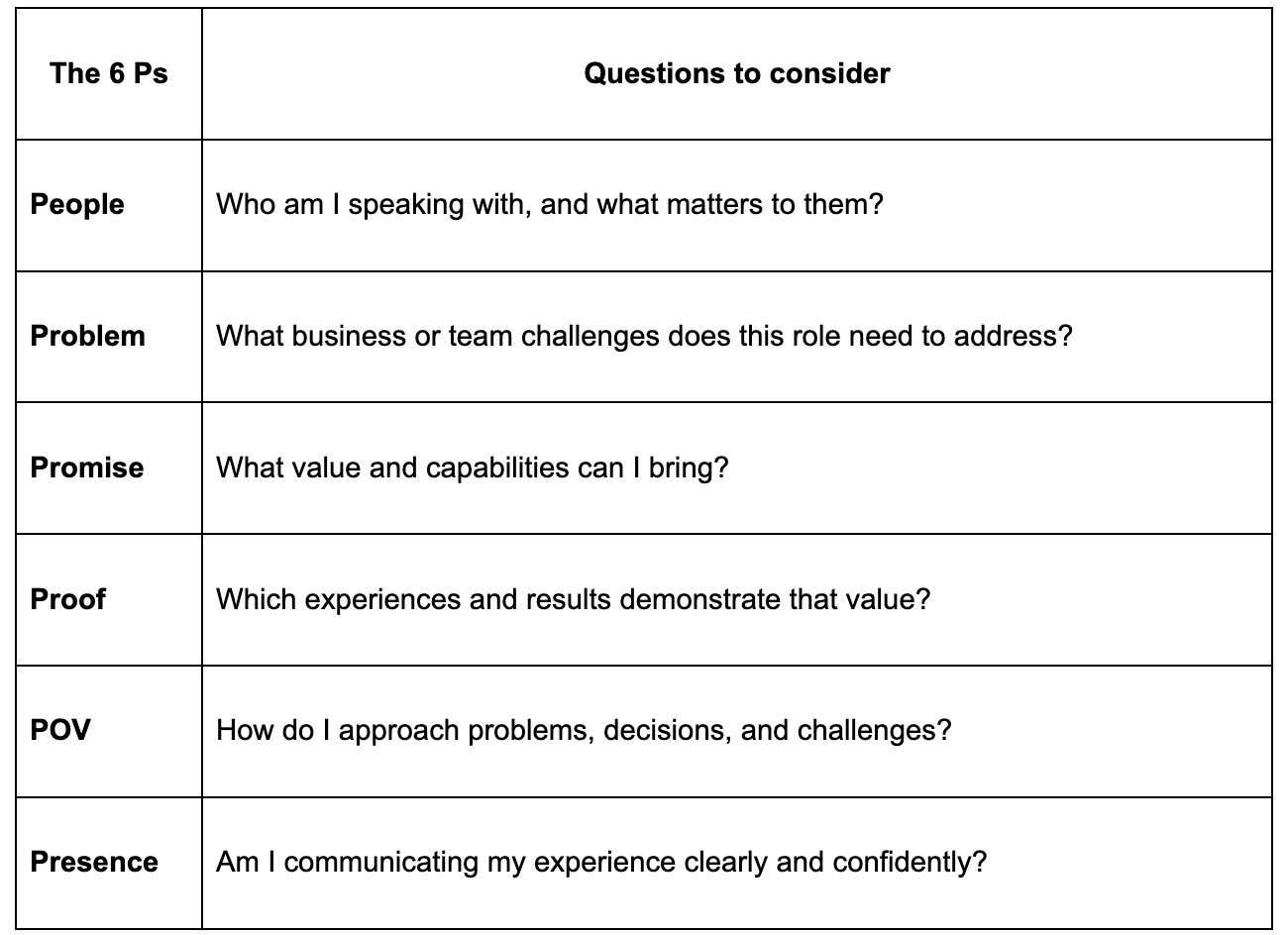
You can also use the following exercise to bring everything together.
Imagine the interviewer asks:
"Why should we choose you for this position?"
Rather than responding with a list of general strengths, build your answer around the six Ps.
You understand the team and its priorities (People). You recognize the challenges the role is expected to address (Problem). You can explain the capabilities and contribution you bring (Promise). You have specific examples that demonstrate your experience (Proof). You can describe how you approach decisions and solve problems (POV). And you can communicate all of this in a clear, confident, and natural way (Presence).
That's what strong interview positioning looks like.
Prepare to Communicate the Value You Bring
A successful interview isn't about convincing someone that you're perfect for the job. It's about helping them understand why your experience, skills, and approach make you a strong candidate for the challenges they're trying to solve.
The 6 Ps give you a practical way to prepare for that conversation. They help you move beyond simply describing your career and start connecting your experience to what the employer needs.
If you'd like help putting these ideas into practice, explore the Free Lab at Collective Career Lab. You'll find resources designed to help you strengthen your professional positioning, prepare your interview stories, improve your resume, and communicate your value with greater clarity.
You can start with the Tell Me About Yourself Worksheet to build a stronger introduction, then use the interview preparation resources to develop examples that demonstrate your experience and strengths.
Explore the Free Lab and access the free resources.
Because standing out in an interview isn't about having the most impressive title or the longest list of accomplishments. It's about helping the interviewer understand what you bring, how you think, and why that matters to their organization.